| Growing the Bennington Co., Vermont landsnail inventory | ||
|
A testimonial to armchair collecting |
||
| By Harry G. Lee | ||
|
The writer has amassed a sizeable collection of Benington Co. landsnails over the last 47 years (Lee, 2004a, b; 2008 a, b) – with each of six major collection campaigns (1961; 2003-2007) the list of species grew. However, with a robust 52 species on the record already, this year (May 22-26) it seemed the principle of diminishing returns might finally be imposed and terminate the skein of successes that marked this reiterative reconnaissance. In fact, after the final processing of soil samples, it appeared the string of victories was broken - nothing different was found. Nothing different indeed. A bit miffed by the apparent shutout with the May, 2008 material, the writer followed his own advice and pored over the rest of the remainder of this county’s productions - the already-curated stuff: about 2,000 specimens from nearly two dozen stations comprising about 200 lots. Armed with some good literature (notably Nekola, 2004 and Pilsbry, 1919, 1946) and his microscope, he looked at virtually every specimen. Mirabile dictu! There were surprises to be had. After sorting, resorting, reading more, sorting and resorting … well, you get the idea, not one, nor two, but three species emerged from concealment amongst look-alike congeners in the shelly “archives,” and two of the three had actually traveled to Florida incognito amongst the May harvest.
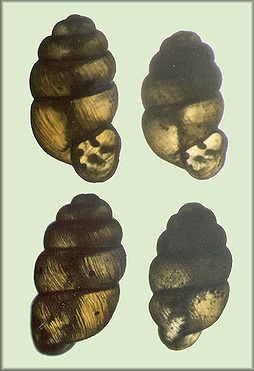
The first “stowaway” was Vertigo bollesiana (Morse, 1865), the
delicate Vertigo. Its shells intermixed with no less than three lots
labeled “V. gouldii* (Binney, 1843), the Variable Vertigo.” The
distinction between these two species was apparently questioned until
Henry Pilsbry (1919: 101-102), attributing this comparison to The genus Euconulus, known as Hives in the vernacular, has always been an irksome taxon for the writer and likely the vast majority of American landsnail enthusiasts. There are very few characters to analyze as the shells are, at first glance, lacking in sculpture and of a monotonous shape. Distinctions among species are subtle and not usually well-expressed in the literature. Consequently, published identifications and species distributions are open to skepticism in many instances. With admitted reluctance, the writer tackled an analysis of the nearly dozen lots of VT Hive shells accumulated over the years. Despite problems presented by a predominance of immature shells, certain features eventually emerged from the rote process of nearly random Hive study. Firstly, there was a difference in the tightness of coil. Shells of the dominant upland (as in mountain marble quarry) form had more whorls in shells of comparable diameter. Secondly, many of the lowland forms (collected close to the bank of the Batten Kill’s West Fork) were quite glossy – particularly on their bases. By comparison the upland tightly-wound shells were distinctly matte or silky in texture. Thirdly, among the glossier, less tightly-wound shells some had higher profiles than others, were of paler coloration, had more subdued spiral grooving on their bases, and, even in the freshest condition, were a little less glossy than the squat forms. Whereas the dark, squat, glossy, striate form was limited to the Batten Kill stations, the taller, loosely coiled, semi-glossy morph seemed to occur in modest numbers in a variety of habitats.
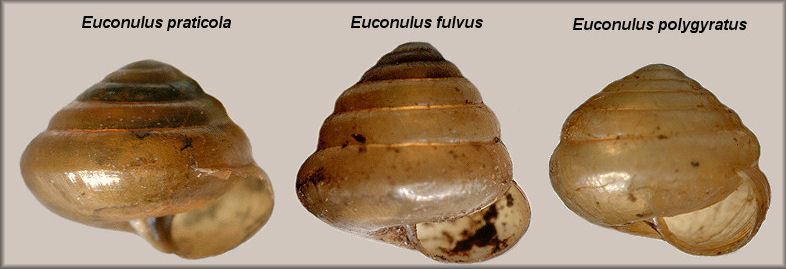
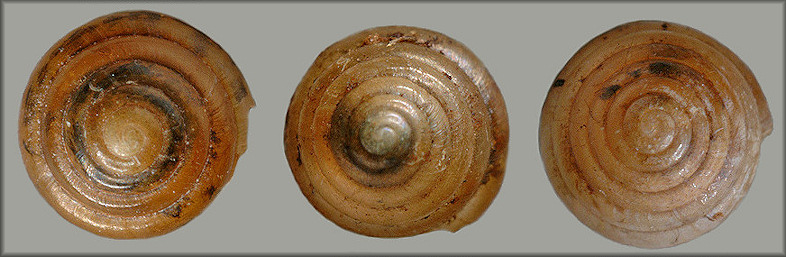
Nekola (2004: 29, 31) seems to have been the first to recognize a “trichotomy” in northern US species of the genus Euconulus Reinhardt (1883b: 856). Analyzing a phenomenal 242 sites personally collected in NE Wisconsin and the adjacent southern Upper Peninsula of Michigan (slightly overlapping the latitude of Bennington Co., VT), he recognized the Holoarctic species E. alderi (Gray, 1840), as well as E. fulvus (Müller, 1774), the Wild Hive, and E. polygyratus (Pilsbry, 1899), the Fat Hive. The last of these was originally and for years regarded as a subspecies of E. chersinus. Reconciliation of Nekola’s descriptions with the figures and text of Pilsbry (1946: 235-242) and the British work by Kerney and Cameron (1979: 148-149) indicated that there were three separate species comprising our Vermont Hives, all of which were thought to be E. fulvus previously. One is dark, shiny, has a low profile, and lives in very moist conditions; the real E. fulvus is taller, paler, and more matte in texture; and E. polygyratus has a rounder profile and tighter coil than the other two (see above). Although Nekola and others, e.g., Kerney and Cameron 1979 and Grimm 1996, used the name Euconulus alderi (Gray in Turton, 1840: 148-149) for the first species, G. Falkner et al. (2002) treated E. alderi as a synonym of E. trochiformis (Montagu, 1803), a European forest-dwelling species, and resurrected the name E. praticola (Reinhardt, 1883a: 40) for the dark, flat, glossy wetland species. R.G. Forsyth of the Royal British Columbia Museum, Vancouver, Canada has followed Falkner et al. and dubbed it the "Marsh Hive" since it was not treated in Turgeon, Quinn, et al. (1998). Inasmuch as "praticola" means "dweller in fields," its brand new vernacular name is much more apt than the "scientific" one. The figures above demonstrate these three species with Bennington Co., VT specimens (L to R: E. praticola, E. fulvus, and E. polygyratus; all about 2.5 mm in diameter). Thus “armchair collecting” proved itself as an indispensible complement to work in the field. It preserved the unbroken VT “string” and allowed the cumulative list to grow from 52 to 55 native species (see below). To paraphrase Mark Twain, there is more than one way to find a snail!
Cumulative list of landsnails collected in Bennington Co., VT (1961-2008)
Carychium exile H. C. Lea, 1842 Ice Thorn 55 species; 27 new county records in blue, of which 13 are new state records (indented) vs. Hubricht (1985). * Amos Binney (1843: 105) named his new species Pupa gouldii. Although many later authors have rendered the species epithet "gouldi," that spelling constitutes an incorrect subsequent spelling or an unjustified emendation, and the binomen Vertigo gouldi is unavailable for purposes on taxonomic nomenclature (ICZN, 1999: 42-43; Article 33.3 and 33.4).
Binney, A., 1843. A critical notice on the species of Pupa
found in the United States. Proceedings of the Boston Society of
Natural History 1:104-105. March 15.
Hubricht, L., 1985. The distributions of the native land mollusks of the Eastern United States. Fieldiana 24(1359): pp. 1-191 + viii. June 28.
International Commission for Zoological Nomenclature (ICZN), 1999. International code of zoological nomenclature fourth edition. pp. 1-306 + i-xxix.
Kerney, M.P. and R.A.D. Cameron, 1979. A field guide to the land snails of Britain and northwest Europe. Collins, London. Pp. 1-288 + 22 color plates.
Lee, H.G., 2004a. Advancing Vermont malacology -or- finding lime recycled after half a billion years of mineral inertia. Shell-O-Gram 45(1): 2-5. Jan.-Feb. <http://www.jaxshells.org/vermont.htm>
Lee, H.G., 2004b. Marble quarry/natatorium also produces conchological gold. Shell-O-Gram 45(5): 6-8. Sept-Dec. <http://www.jaxshells.org/vermontnew.htm>
Lee, H.G., 2008a. Five years later new discoveries continue in the Vermont “Reunion Roundup. Shell-O-Gram 49(2): 3-6. March-April. <http://www.jaxshells.org/vermont07.htm>.
Lee, H.G., 2008b. [“September, 2006 - June, 2007"]. Native snail surveys in Bennington County, Vermont. New York Shell Club Notes 377: 8-15. April. <http://www.jaxshells.org/vermont06.htm> Morse, E.S., 1865. Annals Lyc. Nat. Hist. N. Y. 8: 209, figs. 4-6. [not seen] Nekola, J.C., 2004. Terrestrial gastropod fauna of northeastern Wisconsin and the southern upper peninsula of Michigan. American Malacological Bulletin 18(1-2): 21-44. May 7. Pilsbry, H.A., 1918-20. Manual of Conchology (second series). 25. Pupillidae (Gastrocoptinae, Vertigininae). Academy of Natural Sciences, Philadelphia. ix + 1-401 + 34 pls. Nov. 5 to Apr.
Pilsbry, H. A., 1946. Land Mollusca of North America (north of Mexico) vol. 2 part 1. Academy of Natural Sciences, Philadelphia. vii + pp 1- 520. Dec. 6.
Reinhardt, O., 1883a. Die von den Herren Gebrüder Krause auf ihrer Reise gesammelten Pupa-, Hyalina-, und Vallonia- Arten. Sitzungsberichte der Gesellschaft Naturforschender Freunde zu Berlin 1883(3): 37-43. March.
<http://www.biodiversitylibrary.org/item/35577#page/47/mode/1up>
Photography by the author and David Kirsh; image editing by Bill Frank. |