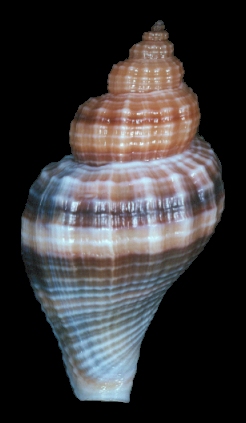
| The Florida Crown Conch - An Update |
| By Phil Poland |
| In my article The Florida Crown Conch, in the January-February
issue of the Shell-O-Gram,
I discussed my experiences with Melongena
corona (Gmelin, 1791). I had concluded that,
in large part, with regards to this species, food makes the form.
At the end of the story, I asked readers for any additional
information they might have on forms from a little visited area
of South Florida. In response to the request, I received a spectacular selection of large Keys forms, and rarely collected transitional forms from Florida Bay at the south tip of Florida. Dr. Henry McCullagh of Jacksonville has visited most of the coast between Chokoloskee and Key Largo, an area largely missed by most authors discussing Melongena corona. It's also an area I haven't been able to sample. In the gift box were two very enlightening lots.
He observed that the smaller, typical forms, as would be expected, fed on Batillaria and small bivalves. Larger forms, to 150 mm, fed on the smaller Melongena of the same colony! These larger forms were often barrel-shaped and with the shoulder and basal spines we associated with the west coast Melongena. A second lot in my gift box was from a beach in Florida Bay, about 16 miles northwest of Key Largo. Here again were Melongena similar to the spineless form, but attaining a larger size when preying upon their own species. A range of forms, as in San Pedro Bay, was found. Dr. McCullagh found that the spineless forms prevail until one gets north of Cape Sable. Northward from where the Shark River meets the Gulf, in his words, "the beautiful, heavy, trigonal and hugely spinose forms start and extend to the Everglades/Marco area." He points out that oyster bars, where I've found the largest forms, do not occur in Florida Bay of the Keys. It seems the snail has found another way to achieve a large size - cannibalism! |