|
Triodopsis messana Hubricht, 1952 Pinhole Three-tooth |
|
|
|
|
|
|
|
| Georgia, Upsom Co., Thomaston. Roland Rd., ca. 7 mi. W town, under fallen limb resting on cleared area immediately adjacent to lawn. Billie Brown! 30 October, 2010. | |
|
Threetooth ID ruminations open a centuries-old amphi-Atlantic Pandora’s Box |
|
|
by Harry G. Lee |
|
|
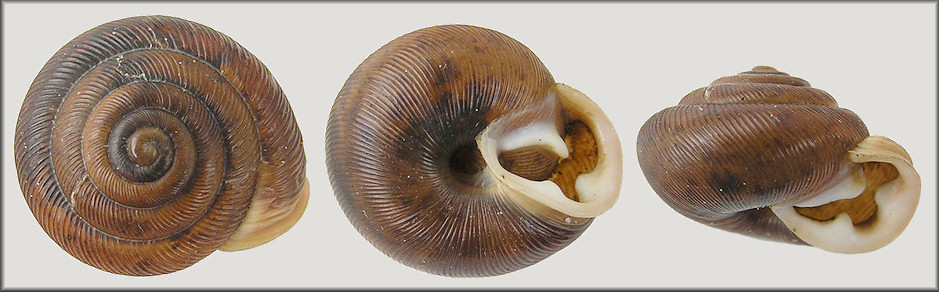
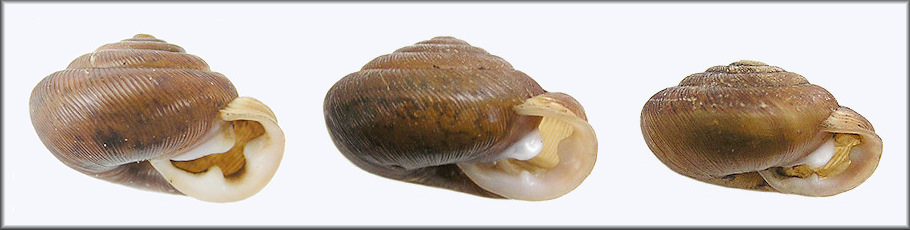
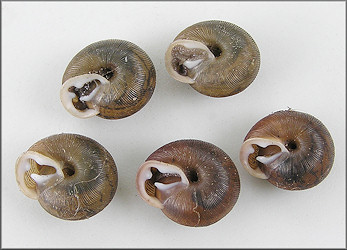
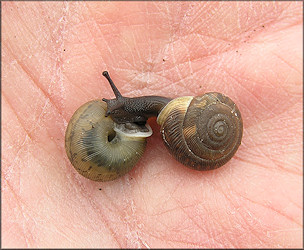
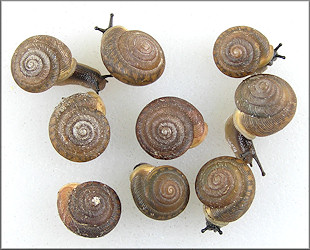
The genus Triodopsis Rafinesque, 1819: 425 [Type Species: T. lunula Rafinesque, 1831 (= Helix tridentata Say, 1817) Rafinesque, 1831 fide Férussac, 1821]* as currently interpreted (Emberton, 1988) is widely distributed in eastern North America, particularly the southeastern US. The conchological identification of the slightly less than thirty species of these so-called “Threetooths” is based on apertural dentition, tightness of coil, umbilical diameter, axial sculpture, pigmentation of fresh material, and zoogeography (see The Genus Triodopsis). That may seem simple enough, but other factors add a degree of difficulty possibly unique to this genus. There is convincing evidence of hybridization among species, and, consequent in part to the ability of some taxa to prosper in human-altered environments, numerous anthropogenic introductions have confused what was certainly a more orderly zoogeographic mosaic before the European immigration. Furthermore, significant intraspecific variation, evident even within a single population, may add complexity. On the other hand, last year Bill Frank and I had created a simple compendium of single images of each of the twenty-eight generally-recognized species of Threetooths (cited above), so I thought identification of four living Threetooths taken by Jacksonville Shell Club (JSC) member Billie Brown in Thomaston, GA would be greatly facilitated. Hours later, I realized that “greatly” was a bit a generous for a description of the ultimate campaign. For openers, these snails didn’t quite match anything in the website portfolio! After ransacking my library, I found a much better match - essentially perfect: paratypes of T. affinis Hubricht, 1954** figured by Grimm (1975: fig 2D). Almost satisfied, I then delved a little deeper and found that Hubricht (1954: 28-30) stated “the only difference between T. messana Hubricht and T. f. affinis is in the color.” As unusual as this dependence on shell coloration struck me, Grimm (1975) seemed to have been in agreement. Next, the original descriptions were consulted. Hubricht (1952: 80-81) characterized T. messana as “reddish brown” [later “dark red-brown to walnut brown” by Grimm (1975)], the largest his cited types series (five) was 15.0 mm in maximum diameter, and he remarked on the variability of the outer lip tooth, in some “pointed and little if any inflected; in others broadly rounded and deep-seated.” He cited Pilsbry (1940: 810: fig. 480 C) but did not otherwise figure this species. In his description of T. fallax affinis (Hubricht, 1954) he used “deep olive buff to wood brown” to describe the shell, the largest of his cited type series (five) was 13.3 mm, and no figure was provided. Both the latter taxa are anthropochorous, meaning able to live in human-altered environments (Hubricht, 1952, 1954, 1971, 1984, 1985; Grimm, 1975), which is consistent with the habitat in which Billie collected her snails; both potentially occur in Upson Co., GA (Hubricht, 1985), where the topical specimens were found, and neither seems to have an authentic figure other than those cited, all graytones. On the one hand, her shells match T. affinis more than they do T. messana based on figures in Pilsbry (1940: fig 480 c) and Grimm (1975; figs. 1E, 1F, 2D) in having a more laterally-expanded aperture and a tighter coil. However, (1) shell color, definitely red brown and darker than the tones indicated for T. affinis, (2) size (from 13.3 to 14.7 mm; three of them over 14.0 mm), (3) outer lip tooth variability (strikingly evident in these four shells), and (4) Hubricht’s (1954) remark about the remarkable similarity between the two taxa, impel me to conclude that Billie’s shells are better referred to T. messana. I feel reasonably confident, based on years of observing variability in this genus, that this is a true instance where a taxonomic determination is better made relying on the salients in the written description than with primary reliance on (authentic) illustration(s). The several images provided with this report are intended to add a dimension to the identity of Triodopsis messana,*** a valid biospecies with a confusing assortment of characters, some variable and others constant. (go to page two) |
|