|
|
|
|
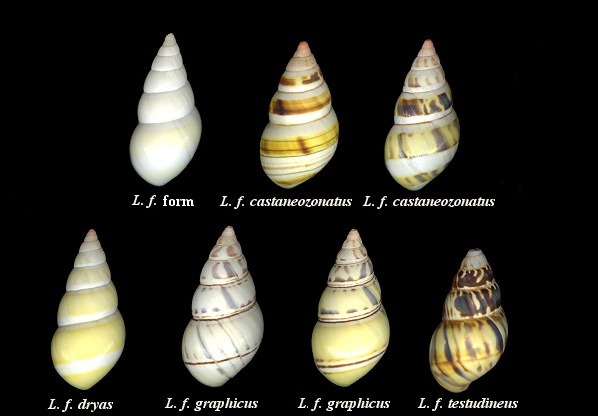
The following are reported from Little Pine Key:
The Little Pine Key L. f. form is almost certainly the "solidus" of Simpson, and not the solidus of Say (an issue we'll skip on this venue). According to Archie Jones, 25% of the shells of this population were pure white and account for many of the shells pigeonholed as crassus. The Little Pine Key L. f. graphicus is distinguished from those of nearby No Name Key, the type locality, by a narrower peripheral band. The Little Pine shells often have markings similar to those of the No Name Key L. f. innominatus and are often labeled as such. These L. f. graphicus vary in ground color from deep yellow to almost white, with one color phase or the other dominant in some colonies. The L. f. castaneozonatus and L. f. testudineus, reportedly released here by Chris Grimshawe over 50 years ago, are very much like their Brickell Hammock (Miami) ancestors and show a considerable amount of variation. |