In The Yard |
|
|
By Bill Frank |
|
|
|
|
|
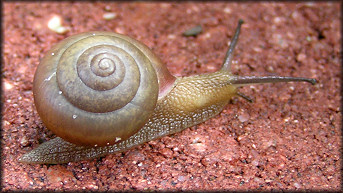
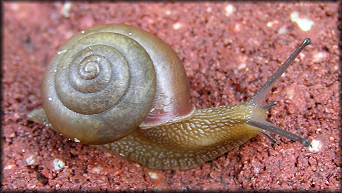
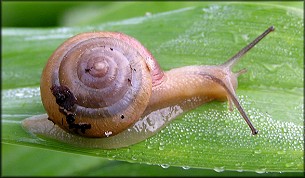
Bradybaena similaris (Férussac, 1821) (about 13 mm.) |
|
|
As has been reported many times in the past in this forum by Assistant Editor Harry Lee, one never knows what terrestrial species may turn up in one's own yard if one is observant and takes the time to do a little investigation. Recently while sitting in my own backyard enjoying the unseasonably warm weather and a beautiful sunset, a snail caught my eye as it was devouring an ornamental plant. Although being quite "snail conscious" and having lived in the same home for eight years, the species was unlike anything previously observed. I collected the specimen, rushed it inside, and did a three-view scan with my flatbed scanner. Alas, despite the little fellow being quite active, I was unable to obtain a scan of the actual animal despite several tries - an event which might have been a first in regards to scanning shells with a flatbed scanner. The resulting image was sent via electronic mail to Harry who immediately identified the species in question as Bradybaena similaris (Férussac, 1821) - commonly known as the Asian Trampsnail and considered by many as an agricultural pest. Since my collection of the first specimen, two additional living specimens have also been found. Thus far, 73 species of terrestrial mollusks have been recorded from Northeast Florida (Duval, Clay, Nassau, and St. Johns Counties) - six of which (including the Asian Trampsnail) are exotic imports. Club records indicate that this species was first recorded in Duval County in 1985 when a specimen was found on a head of lettuce at a local Winn-Dixie Grocery Store. It is theorized that the lettuce came from south Florida. Excluding my recent observation, the species had also been recorded from two locations in west Jacksonville, on citrus trees in Neptune Beach, and it would now seem likely that the species is widespread throughout Duval County - if not all of northeast Florida and beyond.
The species is thought to have originated in south China and spread throughout the world, initially by hitchhiking on cargo transported by ship from Asia. The species has been recorded from many locations ranging from off the east coast of Africa, Australia, South America, and the southern United States - not to mention such diverse locations as Bermuda, Barbados, and the Bahamas. The species has also been collected in Brunswick, Georgia by club member Carol Ruckdeschel. Who knows - you too may find something in your own backyard which is a first - a species which has never before been recorded from northeast Florida - or unfortunately - a species which shouldn't be there at all. * Prologue/epilogue: On 26 February, 2012 Harry Lee corrected the "records" above (his memory): "Ed Cavin, building engineer for the Independent Life Insurance Co., brought me a living specimens of Bradybaena similaris (Férussac) from the shrubbery in the giant conservatory on his building's ground floor. This sub-tropical species originated in China and had reached Africa and the New World through human agency by the Nineteenth Century. The first U.S. record was in Louisiana, but I found a snail in Homestead, Dade Co., Florida in 1976. Fred Thompson of the Florida State Museum knows of other south Florida records. This species' penchant for consuming vegetable matter otherwise fit for the human palate has placed it high on the U.S. Dept. of Agriculture's quarantine list, but it seems the Aggies' battle against these snails is as uphill as that of their counterparts' in Customs vs. cocaine. If B. similaris is naturalized out-of-doors hereabouts: (1) don't be surprised, (2) look for it on the N. E. Florida checklist, and (3) on your collards, lettuce, and tomatoes." (Lee, H. G., 1987. Land snail notes. Shell-O-Gram 28(4): 7-8. July-August. At the time of this writing the snail has spread into much of the state but its agricultural and horticultural impact seems to be of a lower order than implied. |
|