|
A historical review of the Lettered Olive | |
|
by Harry G. Lee |
|
|
The Lettered Olive is one of
the prized finds on beaches from North Carolina (Kurtz, 1860) to NE
Yucatán (Vokes and Vokes, 1964: 56). It is Official State Shell of South
Carolina, which state is also the type locality. |
|
|
|
|
|
|
|
|
|
|
|
Can we be
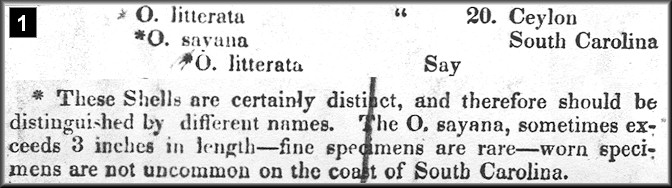
absolutely sure what shell Ravenel intended for his O. sayana?
Tursch et al. (1998: 29) wrote: "The type is missing from the
Ravenel Collection, housed at the Charleston Museum (fide Dr.
Harry D. [sic] Lee, in litt.," which I can confirm.
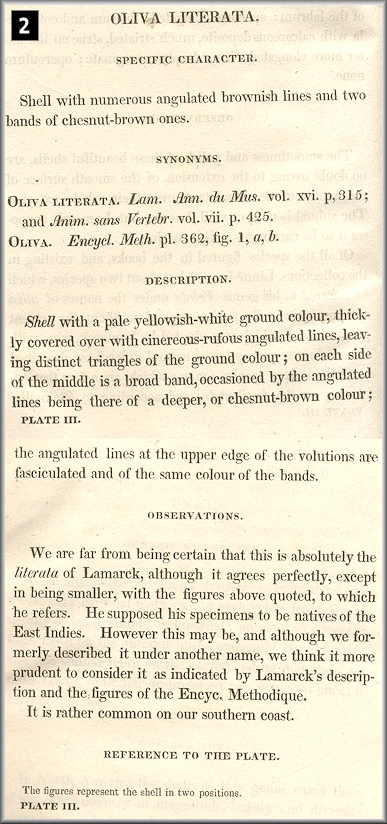
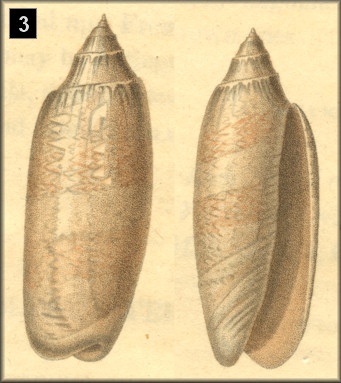
Lacking a type specimen, can the reference I made above to Say hold up
as iconic for Ravenel's species? Gary Rosenberg (2009) wrote: "Ravenel
(1834) did not refer explicit [sic] to Say's American
Conchology, but must have meant that work, in which Say provided an
excellent illustration of the species only four years earlier." I
certainly concur with Gary's analysis as there is copious evidence that
Say and Ravenel were in contact for a substantial period dating to the
latter's attendance at the University of Pennsylvania's School of
Medicine, not far from Say's haunts at the Academy of Natural Sciences,
and from which he graduated as valedictorian in 1819. Thus we may safely
regard the Say illustration as the type figure. Coupling this image with
his statement "sometimes exceeds three inches," I think there can be
little doubt as to the identity of O. sayana Ravenel. ICZN (International Commission for Zoological Nomenclature), 1999. International code of zoological nomenclature fourth edition. I.C.Z.N., London. pp. 1-306 + i-xxix. Kurtz, J.D. 1860. Catalogue of Recent marine shells, found on the coasts of North and South Carolina. Kurtz, Portland, ME. 9 pp. Lamarck, J.B.P.A. de M. de [ed.], 1798. Tableau Encylopédique et Méthodique des trois règnes de la nature vers, coquilles, mollusques et polypiers. Tome second. Agasse, Paris. Planches 287-390. 29 April. Lamarck, [J.B.P.A.deM.C.], 1811 ["1810"]. Suite de la détermination des espèces de Mollusques Testacés. Tarrière. (Terebellum.) Ancillaire. (Ancillaria.) Olive. (Oliva.). Annales du Muséum d'Histoire Naturelle 16: 300-328. Ravenel, E., 1834. Catalogue of Recent shells in the cabinet of Edmund Ravenel, M. D., Ravenel, Charleston. pp. 1-20. Röding, P. F., 1798. Museum Boltenianum sive catalogus cimeliorum e tribus [sic] regnis naturae quae olim collegerat Joa. Fried Bolten, M. D. p. d. per XL. annos proto physicus Hamburgensis. Pars secunda continens conchylia sive testacea univalvia bivalvia & multivalvia. viii + pp. 1-199. 1986 reprint of Sherborn, C. D. and E. R. Sykes 1906 facsimile. American Malacological Union, Inc. Rosenberg, G., 2009. Malacolog 4.1.1: A Database of Western Atlantic Marine Mollusca. [WWW database (version 4.1.1)].
Say, T., 1830. American Conchology, or descriptions of the shells of North America. Illustrated by colored figures from original drawings executed from nature 1. Thomas Say, New Harmony, Indiana. [iii + 36 pp., unpaginated] + plates 1-10. D.D. Turgeon, J.F. Quinn, A.E. Bogan, E.V. Coan, F.G. Hochberg, W.G. Lyons, P.M. Mikkelsen, R.J. Neves, C.F.E. Roper, G. Rosenberg, B. Roth, A. Scheltema, F.G. Thompson, M. Vecchione, and J.D. Williams. Common and scientific names of aquatic invertebrates from the United States and Canada: mollusks, 2nd edition. American Fisheries Society, Special Publication 26. Bethesda, Maryland. ix + pp. 1-509 + 16 pls. (unpaginated). Tursch, B., D. Griefeneder and D. Huart, 1998. A puzzle of highly multiform species: Oliva fulgurator (Röding, 1798) and related American taxa. Apex 13(1-2): 1-61, April 20. Vokes, H. E. and E. H. Vokes, 1984 [“1983”]. Distribution of shallow-water marine Mollusca, Yucatan Peninsula, Mexico. Mesoamerican Ecological Institute, Monograph 1, Middle American |
|
|
|
|