|
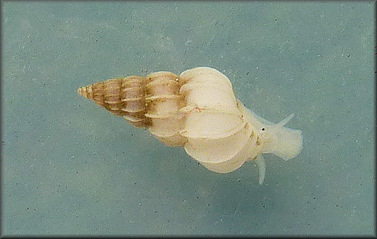
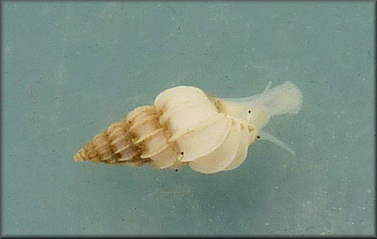
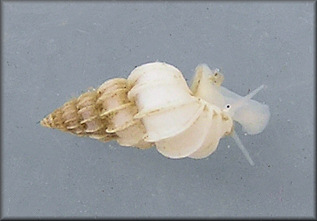
Epitonium sp. aff. albidum (d’Orbigny, 1842) |
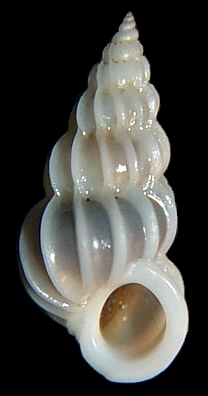 |
| Mayport Naval Station Beach, Duval Co, FL (8 mm.) |
| Also see: Epitonium albidum (d'Orbigny, 1842) |
|
Differs from typical form by appearing more
sturdy, having thicker, more retroflexed costae which thereby twist
at insertion on previous whorl, and by being smaller. Peristome more
thickened and reflected; aperture almost completely rimmed. These
shells closely resemble the form of E. albidum named
Scalaria ligata C. B. Adams, 1850 (see Turner, 1956: pl. 21,
fig. 3), Clench and Turner (1951: 262, fig. 3), and Andrews (1971:
84). Shells from the E. Atlantic identified as E. jolyi
(di Monterosato, 1878) by Chiarelli (1996) may be this species. Also
Lee, Collier, Pinellas, and Levy Cos., FL; LA, TX, and Brazil (Lee,
2009: 94; species no. 450). |